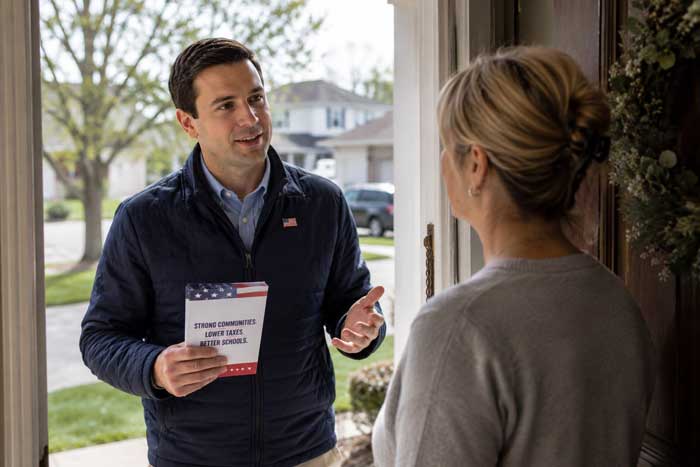
 According to AdImpact, political campaigns and organizations are projected to spend a record 11.6 billion dollars on advertising during the 2025 and 2026 US election cycle.
That is more money than any election cycle in American history.
Campaigns will invest millions in polling.
Millions more in media buying.
Creative agencies will produce thousands of television commercials, digital ads and fundraising videos.
Yet despite that extraordinary investment, some political messages persuade voters while others disappear almost as quickly as they are aired.
Why?
It is tempting to believe persuasion begins with a brilliant slogan, a compelling statistic or the perfect attack line.
After recording hundreds of Republican campaign commercials, I have come to believe persuasion begins much earlier.
It begins with whether people choose to keep listening.
Before voters compare policies, evaluate candidates or decide whether they agree with a message, they make a much faster judgment.
Does this feel believable?
That moment determines whether the message has a chance to work.
Because persuasion rarely begins with agreement.
It begins with trust.
If you’d like to explore how trust is established through delivery, you may also enjoy What Makes a Political Voice Sound Trustworthy?
Understanding that distinction may be one of the most valuable lessons in political communication.
Key Takeaways
- Persuasion begins before agreement.
- Emotion influences attention before logic evaluates facts.
- Clear communication is usually more persuasive than louder communication.
- Every part of a campaign contributes to persuasion, not just the words.
- Trust makes persuasion possible.
Persuasion Isn’t About Winning an Argument
One of the biggest misconceptions in politics is that persuasion happens when one side presents a stronger case than the other.
Real life rarely works that way.
People bring existing beliefs, experiences, identities and emotions into every conversation, not just political ones.
Those don’t disappear because someone presents a better statistic.
Social psychologist Dr. Robert Cialdini has spent decades studying why people say “yes.” His research identified a set of universal principles that influence human decision making, demonstrating that persuasion depends on far more than presenting stronger facts or arguments.
That idea resonates with what I’ve experienced inside the booth.
I’ve never had a campaign consultant tell me,
“Convince them with your voice.”
Instead, the goal is almost always to create an environment where voters are willing to listen.
There’s an important difference.
The voice isn’t there to overpower resistance.
It’s there to remove unnecessary barriers so people can connect with the message.
One campaign from the 2024 election cycle has stayed with me.
The candidate was hearing impaired and spoke openly about how that shaped the way he communicated. Because he had to listen with intention to fully understand what people were saying, the campaign built its message around that strength. Listening wasn’t presented as a weakness. It became evidence of empathy, trust and shared values.
My job wasn’t to make the message sound bigger.
It was to help it sound believable.
That session reinforced something I’ve seen throughout my career.
“People don’t connect because a message is louder. They connect because it feels genuine.”
Emotion Opens the Door to Logic
If trust creates the opportunity for persuasion, emotion often determines whether that opportunity exists in the first place.
Political psychologist Dr. Drew Westen argues that emotion is not the enemy of reason in politics. In The Political Brain: The Role of Emotion in Deciding the Fate of the Nation, he writes:
“In politics, when reason and emotion collide, emotion invariably wins.”
That shouldn’t surprise anyone who works in advertising.
Commercial brands have understood this for decades.
People rarely buy a truck because of its horsepower alone.
They buy confidence.
They buy capability.
They buy the feeling that this vehicle fits who they are.
The same principle applies when someone chooses a financial institution.
Few people read an annual report before opening an account.
They choose the organization they believe will protect their future.
Politics is no different.
Campaigns are not trying to remove emotion from the decision making process.
They’re trying to connect with voters in ways that acknowledge what they already care about.
- A parent worried about rising grocery prices.
- A small business owner concerned about taxes.
- A veteran looking for stronger leadership.
- A young family wanting to feel safe in their community.

Facts still matter.
Policy still matters.
But people are far more likely to consider those facts after they feel that a campaign understands their concerns.
Emotion does not replace logic.
Emotion determines whether people are willing to engage with logic in the first place.
Great Campaigns Create Clarity, Not Noise
Republican messaging strategist Frank Luntz, best known for Words That Work, has spent decades studying how language shapes public opinion through extensive voter research and focus groups.
During a PBS Frontline interview about political messaging, Luntz made an observation that has always stayed with me:
“It’s all emotion. But there’s nothing wrong with emotion.”
One of the reasons I appreciate Frank’s work is that he approaches communication as a student of human behaviour. His conclusions are grounded in research, testing and listening to voters rather than simply offering opinions. His work reminds us that effective messaging begins with understanding how people actually receive information.
That doesn’t mean facts don’t matter.
It means facts rarely matter if people stop listening before they hear them.
I’ve seen campaigns revise a single sentence dozens of times.
Not because the policy changed.
Because the wording changed how people felt.
That’s not manipulation.
It’s communication.
The most persuasive campaigns don’t necessarily have the loudest message.
They have the clearest one.
Every Part of a Campaign Persuades
It’s easy to think persuasion happens when the television commercial airs.
By then, most of the persuasive work has already been done.
Polling has identified voter concerns.
Strategists have developed positioning.
Copywriters have shaped the narrative.
Designers have built the visual identity.
Media buyers have determined where the message appears.
Voiceover is simply the final expression of all those decisions.
When every part points in the same direction, the campaign feels authentic.
When they don’t, voters may never know exactly what’s wrong.
They simply sense that something doesn’t fit.
And once that feeling appears, trust becomes much harder to earn.
After hundreds of political recording sessions, I’ve learned that consistency is persuasive because consistency builds trust.
Persuasive Communication Versus Persuasive Performance
Campaigns That Struggle
- Winning arguments
- More information
- Louder messaging
- Performing for voters
- Talking at voters
- Trying to persuade
Campaigns That Connect
- Building trust
- Better understanding
- Clearer messaging
- Connecting with voters
- Sharing a vision with voters
- Giving people a reason to listen
What This Means for Campaign Consultants
Every campaign wants to persuade.
But persuasion isn’t created by a single speech, commercial, slogan or, in my case, a voice actor.
It’s created when strategy, messaging, visuals, language and delivery all reinforce the same story.
That’s why I’ve never believed voiceover is about having a great voice.
It’s about helping a campaign communicate in a way that feels completely believable.
People rarely change their minds simply because someone speaks louder.
They change their minds when a message feels credible enough to deserve another thought.
Looking Ahead
Not every political message will persuade every voter.
Nor should it.
Effective persuasion is not about finding one argument that works for everyone.
It is about understanding the people a campaign needs to reach and communicating with enough clarity, consistency and credibility to earn their attention.
Facts matter.
Policy matters.
Strategy matters.
But none of them can influence someone who has already stopped listening.
The campaigns most likely to connect are not always the ones making the most noise.
They are the ones giving voters a reason to listen.
Your Campaign Has a Story to Tell
If you’re producing Republican campaign advertising and need a voice that understands how strategy, messaging and delivery work together, I’d be glad to help.
I provide authentic political voiceover, fast turnaround, live directed sessions and Source Connect capability for Republican campaigns, political consultants and advertising agencies across the United States.
Let’s talk about how the right voice can help your message connect.


